
a paranoid year
Eve Kosofsky Sedgwick and the predictive impulse

Has it really been since July? I guess so. Ample time for many things—see “what I’ve been up to” for a narrow selection.
A note that this post includes light discussion of the occupation of Minneapolis + other assorted troubling events, though there’s nothing graphic. I hope you are taking care.
Recently I re-read Eve Kosofsky Sedgwick’s “Paranoid Reading and Reparative Reading.”1 Sedgwick was a brilliant literary scholar, known mostly for her pioneering work in gender studies and queer theory, gone far too soon from breast cancer in 2009. “Paranoid Reading” (whose title I do not endorse—it was the 2000s and all that) is part of her book on affect theory, Touching Feeling (2003). I like this collection a lot; I’ve written about its introduction in another essay before.
Sedgwick’s concept of “paranoid reading” is named in a rather poorly-understood rendering of schizophrenia, which did sour me on the concept on my first reading. But this time, when I read it in the first week of January for a class, it felt transformative. Sedgwick begins the piece with the following anecdote, which I will quote in its entirety:
Sometime back in the middle of the first decade of the AIDS epidemic, I was picking the brains of a friend of mine, the activist scholar Cindy Patton, about the probable natural history of HIV. This was at a time when speculation was ubiquitous about whether the virus had been deliberately engineered or spread, whether hiv represented a plot or experiment by the U.S. military that had gotten out of control, or perhaps that was behaving exactly as it was meant to. After hearing a lot from her about the geography and economics of the global traffic in blood products, I finally, with some eagerness, asked Patton what she thought of these sinister rumors about the virus’s origin. ‘‘Any of the early steps in its spread could have been either accidental or deliberate,’’ she said. ‘‘But I just have trouble getting interested in that. I mean, even suppose we were sure of every element of a conspiracy: that the lives of Africans and African Americans are worthless in the eyes of the United States; that gay men and drug users are held cheap where they aren’t actively hated; that the military deliberately researches ways to kill noncombatants whom it sees as enemies; that people in power look calmly on the likelihood of catastrophic environmental and population changes. Supposing we were ever so sure of all those things—what would we know then that we don’t already know?’’
What would we know then that we don’t already know. I can tell you that reading that, I knew Sedgwick had got the goods.
Sedgwick defines “paranoid reading” as exactly this sort of tendency: reading a text, an object, an event, etcetera (in the humanities-academia sense of “read”) through the lens of what we already know about it, seeking to expose rather than to learn. She cautions us against this. We can never actually learn from anything if we’re always shouting what we know over it. Even if we’re right, again—what does it tell us that we don’t already know? The answer is: nothing. Sedgwick’s “paranoia” comes from a fear of bad surprises. In seeking to avoid bad surprises, it avoids all surprises, period, and in so doing, forecloses the possibilities of learning, growth, and freedom.
Sedgwick then gives five tenets of her “paranoia” concept:
Paranoia is anticipatory.
Paranoia is reflexive and mimetic.
Paranoia is a strong theory.
Paranoia is a theory of negative affects.
Paranoia places its faith in exposure.
Of these, I think the most useful quality (and the one requiring the least explanation) is the last one: that Sedgwick’s “paranoia” places its faith in exposure—it is so focused on avoiding bad surprises that it mistakes loud anticipation for action. This is the part that really shook me, and has stuck with me for the past several weeks. What would we know then that we don’t already know? The answer of “not much,” to me, is incredibly liberating.
I have always had a deep fear of the future. When I was a kid, I was actually jealous of people older than me because they’d have to live through less of the climate crisis than I did, which sounds fake but was terribly real. It felt awful. Though these days I do have some semblance of a five-year plan, it’s still very hard for me to think clearly about the future, especially when things seem quite bad in the present. My natural mode seems to be this “paranoid reading,” the belief that I must anticipate the worst-case scenario at all costs, ostensibly so that I can prevent it or numb the blow—even when it’s totally out of my control.
What is the alternative? Sedgwick contrasts “paranoid reading” with “reparative reading”—an openness to being surprised by what happens next. This isn’t the same as optimism. It’s just an abandonment of the futile need to know the rest of the story, to be prepared, to be unsurprised. For the past month or so, I’ve been trying, hard, to do that.
Affectively, it’s been an awful year. I frequently spiraled unavoidably about avoiding bad surprises. My choice to stay in Montréal had to do, among other (good!) things, with that bad-surprise avoidance, but there were bad surprises anyway, due to more mundane things: bureaucracy, burnout, a bad case of Covid, the death of my grandmother, the shooting at Brown, a bad case of the flu. I spent the fall mostly in a state of despair. Amid that gloom, I felt totally smothered by what my friend Jess calls “the Circus” of AI, full of credulous nonsense from researchers who really should know better. I read the news too much and thought a lot about wanting to be back in the States. Not because I thought my presence would change anything but because it felt so awful to sit on the other side of the border, not even able to do little things to take care of the people I love.
Don’t get me wrong—this past year has been outrageously, almost unbelievably, successful, and has had many bright spots throughout. Since January 2025 I published two co-translations with my dear friend Lénaïg Cariou, one of them being our first published book in English. I got accepted to multiple PhD programs and picked one; I met some wonderful collaborators; I did a lot of readings on multiple continents; Lénaïg and I won two translation prizes; I submitted my thesis and graduated with my Master’s. It’s so cliché, but though on paper it was a good year, emotionally I think it was one of the hardest I’ve ever had.
It’s hard to not get stuck in exposing the worst of what might happen in the future, but what Sedgwick’s essay really gets at is that it does nothing for us. A day after I reread “Paranoid Reading” was the shooting of Renée Good. And though my friends and I had been talking about how bad things could get under Trump since the day he was reelected, though I’d wondered in the pages of this newsletter if it was, or would become, the kinds of circumstances that chased my own ancestors out of Europe, this kind of thinking was no help nor comfort to me. The thing about “paranoid reading” is that even if you’re right, being right isn’t what helps. Action is.
Ironically, “paranoid reading” winds up being quite a useful analytical frame for exposing when we are critiquing for critique’s own sake, or just for the sake of exposure. I’ve been thinking about how it maps onto my gripes about the “motivating examples” in fairness research, and indeed to fairness research in general, which has often resorted primarily to exposure rather than remediation. What I’ve been finding useful about this lens, as someone who habitually avoids or anticipates the bad surprise, is that it helps me acknowledge the situation and reorient myself away from fixation on the problem. To let the bad surprises happen, because they’ll come no matter how well I anticipate them—not out of capitulation, but towards repair.
What I’ve been up to
Back in September (!) I went to Belgium to the Poetik Bazar with Lénaïg! It’s the first international translation speaking thing I’ve been invited to, and it was really interesting seeing the flavors of institutional multilingualism/siloed monolingualism in Belgium after living in Montréal. I also got to see the oldest surviving printing presses in the world and ride a wooden escalator in Antwerp.

Hebrew lead type for the Plantin Polyglot at the Plantin-Moretus Museum That trip also gave me Covid which I canNOT recommend. I further will reiterate that you should wear a mask (I wear one on transit, in the grocery store/pharmacy, and in big crowded rooms if I can) and REST if you get it. I had four weeks of crushing fatigue and feel lucky to have made a full recovery.
I graduated with my Master’s and the robe I had to wear was pretty strange. Canada!
I spent Halloween in New Orleans, dressing up as a flock of geese with my friends.
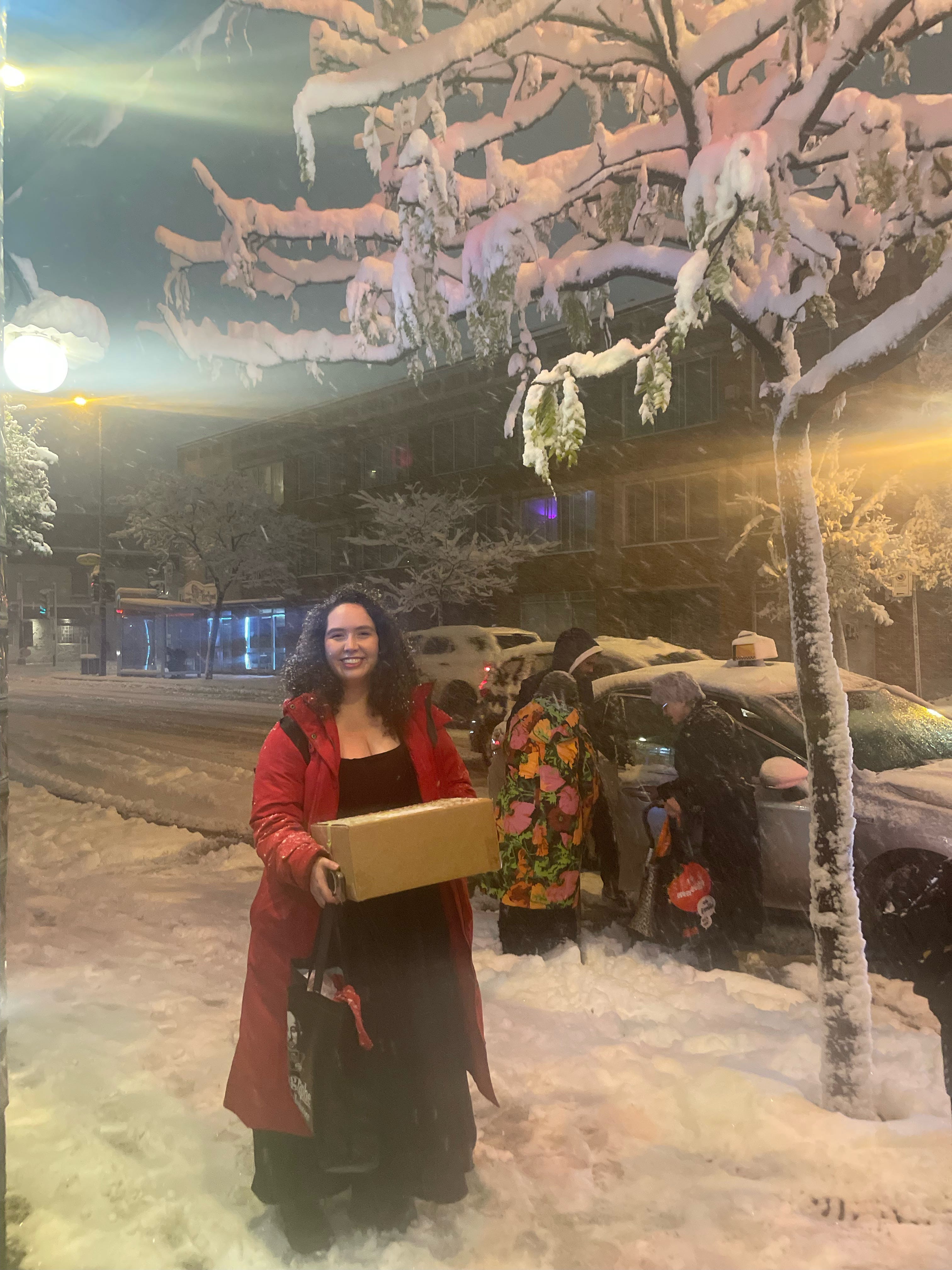
Lénaïg and I won the Québec Writers’ Federation Cole Foundation Prize for translation! It was a magical night, as it was also the first snow of the winter in Montréal.
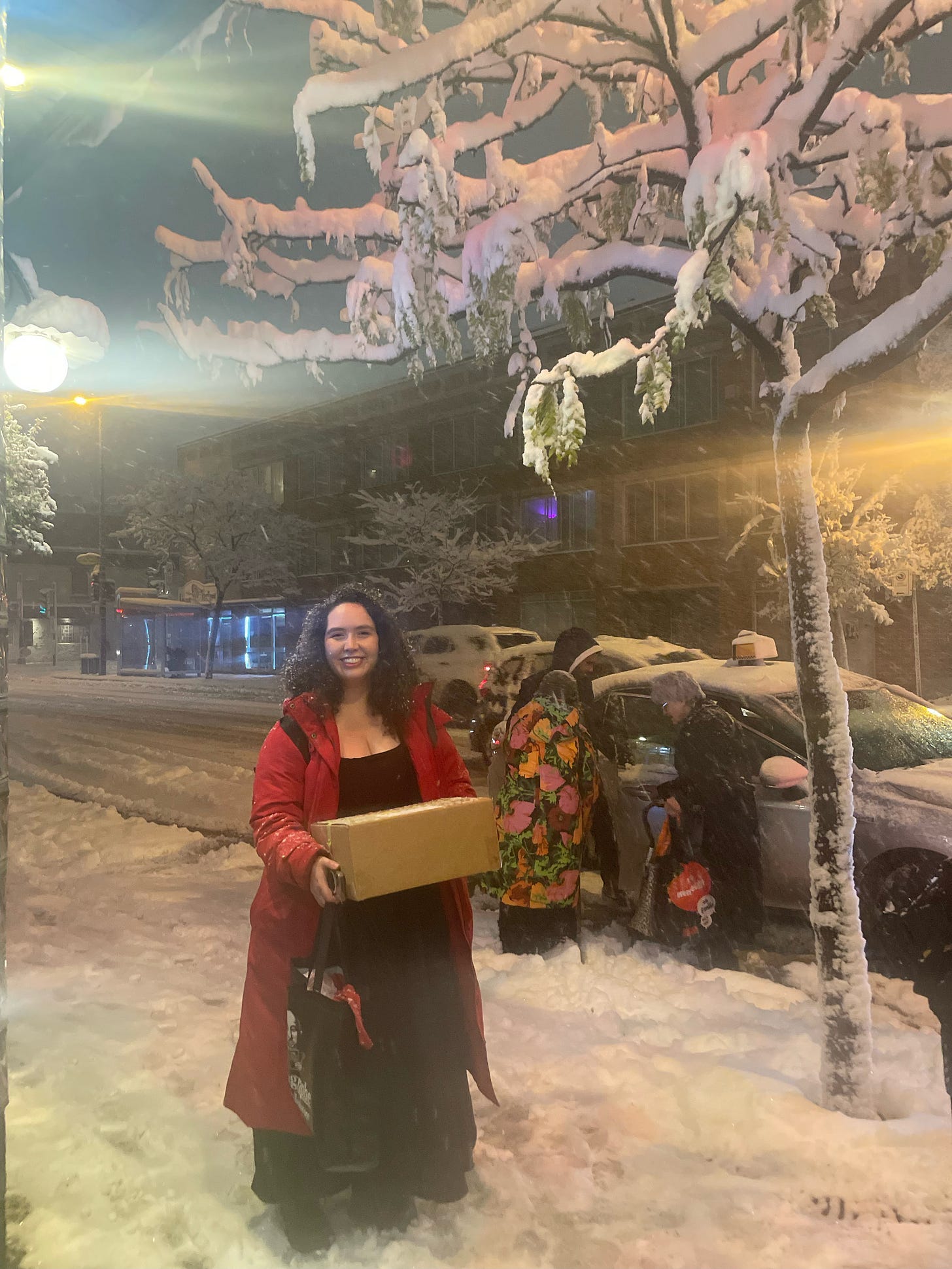
outside Cabaret Lion D’Or My grandmother passed away in December. She was a legend but also could be quite mean. Maybe I’ll write a full post about her and the weirdness of the shivah, during which I also got the flu.
I loved watching the Olympics, especially through CBC’s broadcasts, which are so much better than NBC. I fear the US overtime Gold Medal wins have made me feel more Canadian than I have before.
I have enjoyed having a big real winter as well! But I won’t admit it hasn’t been challenging. The seasonal depression is doing its thing and I did totally wipe out on the ice the other day.
I’m editing Kernel Magazine this winter!! Alas, we’re no longer open for pitches, but I’m really excited about our theme, FEED!

The full essay title is “Paranoid Reading and Reparative Reading, or, You’re So Paranoid,You Probably Think This Essay Is About You.” Academics are ever thus.